Murray Shankar
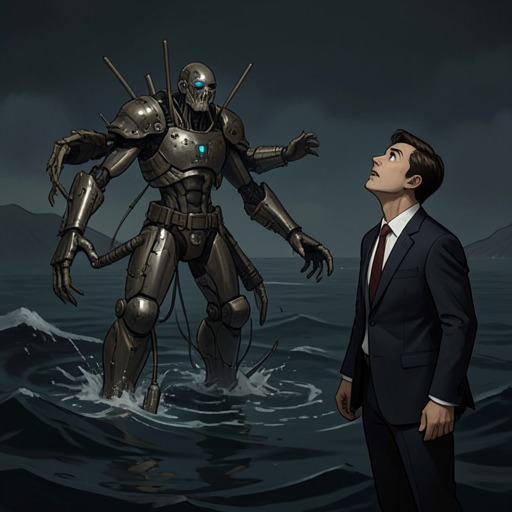
The SwarmMurray Shankar is SOSUS’s lead acoustician, the scientist who helps turn the ocean’s unidentified sounds into evidence of intelligence and, eventually, an exchange with the Yrr. His importance lies not in a lone act of discovery but in patient interpretation: listening again, reshaping what can be heard, and recognizing that a signal need not resemble human speech to carry meaning.
Identity and Scientific Role
Shankar leads the acoustic work for SOSUS and is called in to help make sense of noises the team cannot identify. He and his colleagues play Scratch and other spectrograms repeatedly, treating the recordings not as a solved message but as material that must be examined from different angles. His work belongs to a larger network of listening: signals can be picked up by systems on shore as well as by the research team at sea.
When Samantha Crowe joins the operation, Shankar is introduced as SOSUS’s lead acoustician. He later works beside her in the Combat Information Center, where their task is both technical and interpretive. The equipment can register a sound; it takes careful analysis to decide what kind of sound it is, how it travels, and what conclusions the evidence permits.
From Scratch to a First Message
Shankar helps make the first deliberate transmission into the deep. He chooses a frequency that matches the spectrum of the unidentified noises SOSUS has named Scratch. The signal is then modulated, but reflections distort it. In the Combat Information Center, he and Crowe adjust the modulations until the distortion is removed. Their aim is to make the transmission detectable by any creature capable of sensing acoustic signals, without assuming that the Yrr will understand it or reply.
The listening operation extends beyond the USS Independence. Radio operators are instructed to watch for a response, while Shankar’s SOSUS team and other electronic systems on shore are also listening. If a reply is detected across the Atlantic Ocean hydrophone array, the differences in arrival time between hydrophones can help calculate its point of origin. Shankar’s work is therefore part of a distributed process: the ship sends a message, but the broader network may be what reveals an answer.
When a low-frequency signal arrives near the USS Independence, Shankar identifies its pattern as the same as Scratch. That recognition connects the new sound to the earlier unexplained recordings, but it does not yet make the signal transparent. Shankar and Crowe distinguish the possibility of a shared signal system from the question of how its ordinary use works. The sounds humans have received may not be a straightforward sample of the Yrr’s normal language.
Decoding and Contact
Shankar explains that Scratch is not simply a human-style language encoded in an unfamiliar format. He compares the transmitted message to the Arecibo message: computers can send a structured signal that people themselves do not ordinarily use in conversation. To expose the message’s components, the team slows the low-frequency sound down. What first resembles a continuous scratching noise resolves into separate pulses whose lengths and intensities vary, a pattern that seems to operate somewhat like Morse code.
That analysis provides a way to understand the specific signal, not a complete key to Scratch. The team still cannot interpret the earlier Scratch transmissions, and the researchers do not know how the Yrr use their signaling system under ordinary conditions. Shankar’s distinction is important: partial understanding is not the same as having deciphered an entire language. The breakthrough is that the scientists have established contact through a form they can analyze.
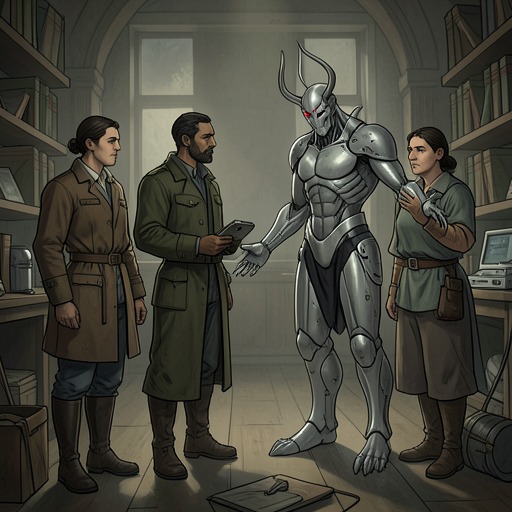
The first test is mathematical. Shankar shows the gathered team rows of numbers and explains that they had sent problems asking the recipients to continue decimal sequences, solve logarithms, and supply missing numbers. The answer returns every problem correctly. In the scene, his presentation makes the result legible as more than a noise or coincidence: the Yrr have received the challenge, manipulated mathematical information, and returned a response in a structure the humans can recognize.
Crowe draws the further conclusion that the Yrr can adapt Scratch so humans can understand it. The successful answer does not merely suggest intelligence; it demonstrates an ability to decode a message and encode a reply. Shankar also brings up an image on the screen after the numerical response. The image is treated as part of the exchange, though the evidence does not establish its contents. His role remains that of the acoustician who helps deliver and interpret the form of the communication, not an all-knowing translator of its meaning.
Disagreement and Ethical Stakes
Shankar’s scientific work unfolds amid disagreement over whether the ocean’s anomalies point to a parallel intelligence. During the argument over Sigur Johanson’s theory, Shankar is initially counted among Jack Vanderbilt’s opponents of the hypothesis, alongside Stanley Frost and Bernard Roche. After Salomon Peak changes sides, Shankar, Frost, and Roche follow. The reversal places Shankar among those willing to reconsider their position as the evidence and debate develop; it does not make the dispute merely technical. The division also exposes how difficult it is for human observers to accept the possibility of an intelligence that challenges humanity’s assumed supremacy.
By the final reflections, Shankar gives that challenge an ethical dimension. His gentle voice argues against treating the Yrr as a wonder whose strangeness justifies destroying it. He points to a familiar pattern in which people become fascinated by unfamiliar creatures and then kill them, and asks what human efforts to communicate were ultimately meant to achieve if the intended result was the Yrr’s eradication. His position reframes contact as a moral test: curiosity and admiration mean little if they lead only to extermination.
Death and Remembrance
Shankar dies during the catastrophe aboard the USS Independence. The available account confirms his death but does not detail its circumstances. A year after the ship sinks, Samantha Crowe includes him among the dead she and Leon Anawak discuss, alongside Sigur Johanson, Sue Oliviera, Alicia Delaware, and Jack Greywolf. Her remembrance situates Shankar within both the personal loss of the expedition and the scientific effort whose consequences outlasted it.
His narrative arc runs from listening to an unintelligible sound, through the labor of shaping and testing a reply, to a final defense of the life that the message addressed. The response to the mathematical problems proves that communication was possible; it does not guarantee that humans will respond with restraint. Shankar’s work helps establish the Yrr as communicative beings, while his concluding argument insists that recognition must change what humans are prepared to do.